



Wissenswertes
Forschungsstelle Osteuropa
Die Forschungsstelle Osteuropa (FSO) ist als An-Institut eine außeruniversitäre Forschungseinrichtung an der Universität Bremen. Sie wird gemeinsam von der Kultusministerkonferenz und dem Land Bremen finanziert. Im Jahre 1982 mitten im Kalten Krieg gegründet, versteht sich die FSO heute als ein Ort, an dem der Ostblock und seine Gesellschaften mit ihrer spezifischen Kultur aufgearbeitet sowie aktuelle Entwicklungen in der post-sowjetischen Region analysiert werden.
Aktuelle PressebeiträgeEnergiekrise durch Iran-Krieg: Russland profitiert, aber „kann selbst seinen engsten Partnern nicht helfen“» weiterlesen Zwischen Verdrängung und Verantwortung: Vier Jahre Angriffskrieg gegen die Ukraine » weiterlesen |
Aktuelles aus Forschung & ArchivNeue Publikationen zur Ukraine» weiterlesen Alltagshilfe für tschechoslowakische Migrant:innen » weiterlesen |
Archivale des Monats
‘Children of the Gulag’
Irina Emelyanova and the Impact of Her Mother Olga Ivinskaya’s Arrest
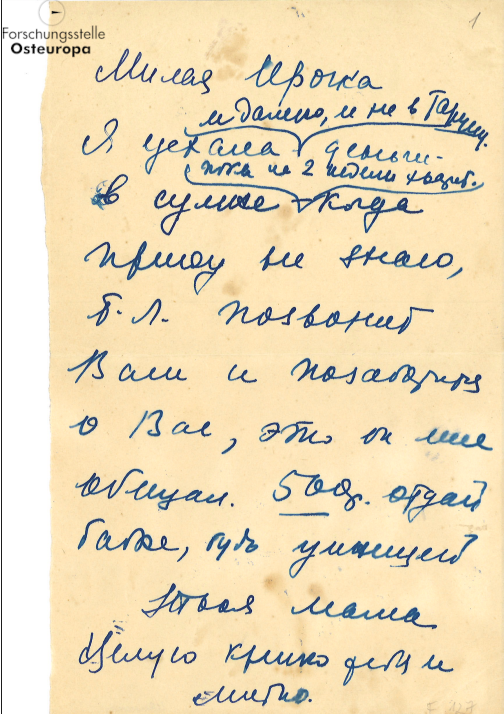
A note written by Olga Ivinskaya to her daughter Irina Emelyanova during her arrest. 6 October 1949. Archive of the Research Centre for East European Studies. Photo: Elizaveta Olkhovaia.
“Dear Irochka,
I have left (…). I have some money in my purse (it should be enough for two weeks), but I don't know when I'll be back. B. L. will call you and look after you, he promised me he would. Give 500 rubles to your grandmother and be a good girl.
Your mum.
I kiss you and Mitya tightly”
Olga Ivinskaya (1912—1995), a Soviet editor and translator, wrote this note to her daughter, Irina Emelyanova, during Ivinskaya’s arrest on 6 October 1949. Irina, who was at school during the arrest, was 10 years old, and her brother Mitya was 7. In the note, Ivinskaya deliberately uses veiled language, probably to spare her daughter some of the horror of the situation.
Emelyanova recalls being “at the age when you already remember everything, but still don't understand much”, and worrying about the things that adults wouldn't notice: if the book she had borrowed from a classmate would be confiscated along with others, or if she could change water for the pet fish. Her great-aunt, whose husband had been arrested and shot in 1937, explained to her what happened. Emelyanova writes that her mother’s arrest played the biggest role in her life and was the first she remembered clearly: “The first tapping on the walls, grandfather's whisper: ‘Are they looking for gold? A hiding place?’ (...) Waking up the next morning. How can I go to school? How do I talk about it? How do I live?”
For ‘children of the Gulag’ — those whose parents were branded enemies of the Soviet regime — a parent’s arrest often meant being sent to a children’s home. Siblings were usually separated and children often sent far from their hometowns, to better ‘reforge’ them into ‘proper Soviet citizens’; many never saw their family again. Emelyanova and her brother were relatively fortunate: after night-long attempts to persuade the KGB, her grandparents (her grandmother spent five years in the Gulag herself) were finally granted custody. They were also cared for by Boris Pasternak (“B.L.” in the note), the author of “Doctor Zhivago” (1957), and Ivinskaya’s friend and lover. His financial support during that time, Emelyanova recalls, saved the family from abject poverty.

Olga Ivinskaya, Boris Pasternak, Irina Emelyanova. Late 1950s. Archive of the Research Centre for East European Studies. Photo: Elizaveta Olkhovaia.
Even for children who could stay with their relatives, the label of ‘child of the people’s enemy’ would become a stigma, leading to social ostracization and bullying. Many would hide their circumstances: Emelyanova remembers once cutting her hand “to run out of class supposedly to see a doctor, but in reality to escape an unexpected questionnaire conducted by the new head teacher — my parents' profession…”
Ivinskaya received five years and was released early in April 1953, shortly after Stalin’s death. However, neither she nor her daughter escaped the Soviet repressive system for good. Both Ivinskaya’s arrests (her first indictment included “praising the work of the anti-Soviet writer Pasternak”) were closely connected to Pasternak. Shortly after his death in May 1960, both Ivinskaya and Emelyanova were accused of receiving royalties for “Doctor Zhivago”’s publication abroad. They spent their sentence together, in a political camp in Mordovia, near where Ivinskaya had spent her first sentence. Irina Emelyanova was released in July 1962, Olga Ivinskaya in October 1964.
Olga Ivinskaya passed away in Moscow in 1995, aged 84. Irina Emelyanova emigrated to France in the 1980s. She donated her family's archive to the FSO in 2000.
Elizaveta Olkhovaia
Further reading:
Emelianova, Irina: Legendy Potapovskogo pereulka. B. Pasternak, A. Efron, V. Shalamov: vospominaniya i pisma, Moscow 1997.
Frierson, Cathy A.; Vilensky, Semyon S.: Children of the Gulag, New Haven, 2010.
Ivinskaya, Olga: A Captive of Time: My Years with Pasternak, London 1978.
MacKinnon, Elaine: "The forgotten victims: Childhood and the Soviet Gulag, 1929–1953, in: The Carl Beck Papers in Russian and East European Studies 2203 (2012), p. 1-68.
Elizaveta Olkhovaia is a PhD student at the Research Centre for East European Studies Bremen and writing her thesis on female political prisoners in the late Soviet Union.
Länder-Analysen
» Länder-Analysen
» Eastern Europe - Analytical Digests
Discuss Data
Archiving, sharing and discussing research data on Eastern Europe, South Caucasus and Central AsiaOnline-Dossiers zu
» Erdgashandel
» Hier spricht das Archiv
» Russian street art against war
» Dissens in der UdSSR
» Duma-Debatten
» 20 Jahre Putin
» Protest in Russland
» Annexion der Krim
» sowjetischem Truppenabzug aus der DDR
» Mauerfall 1989